


Turner Gear for Wind Turbine Blade Installation
Installing wind turbine blades is a complex operation where precision, control and safety are critical. During installation, the rotor is exposed to significant forces, especially when only one or two blades are mounted. In this phase, the system is inherently unstable and difficult to manage. A Turner Gear plays a key role in addressing this challenge. It enables controlled rotation of the rotor during installation, ensuring that each blade can be positioned accurately and safely. In the wind industry, this tool is often referred to as a turning gear or turn gear and is a standard part of modern blade installation processes.
This article explains what a Turner Gear is, why it is essential, and how it contributes to safe and efficient wind turbine blade installation.
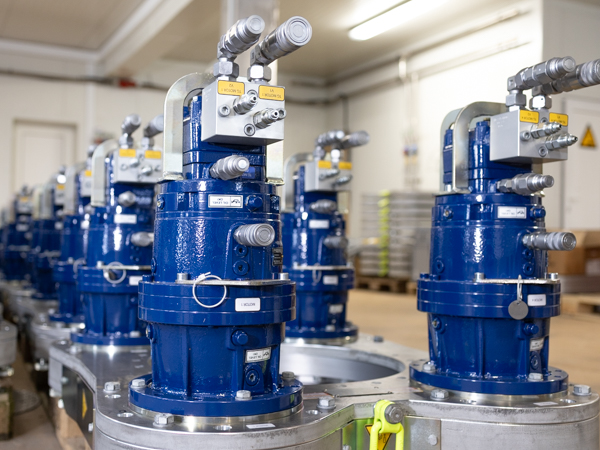
Turner Gear units tested and prepared for delivery to wind turbine blade installation projects.
What is a Turner Gear (Turning gear / Turn gear)?
A Turner Gear is a temporary installation tool used to rotate the rotor or hub of a wind turbine in a controlled manner during blade installation. It is not a permanent part of the turbine but is used only during specific installation or maintenance phases. The primary function of a Turner Gear is to provide controlled rotational movement, allowing technicians to position the rotor precisely so that each blade can be mounted at the correct angle and orientation.
In principle, a Turner Gear works similarly to traditional turning or jacking gear systems used in other heavy industries. However, it is specifically designed to handle the size, weight and dynamic forces associated with wind turbine rotors. Turner Gear systems deliver high torque, allowing movement of large components under load. Rotation is powered by a hydraulic unit, with most solutions using simple mechanical control. More advanced systems, such as those delivered by AS SCAN, are PLC-controlled, enabling precise and safe operation. This controlled movement ensures that installation work can be carried out in a stable and predictable manner.
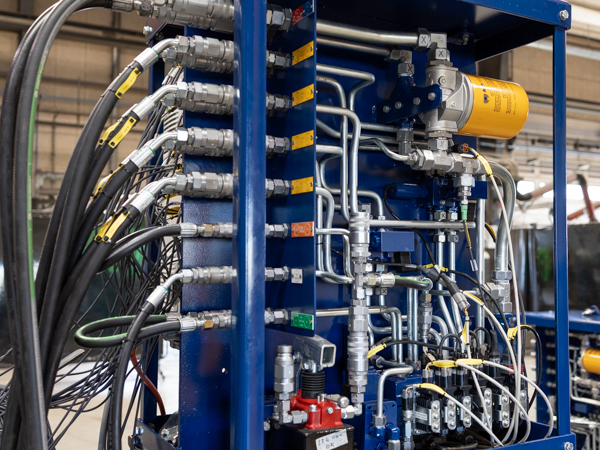
Hydraulic control station under testing as part of a Turner Gear system for wind turbine installation.
Why is rotor control critical during blade installation?
Rotor control is one of the main challenges during wind turbine blade installation. When a turbine is fully assembled with all blades mounted, the rotor is balanced. During installation, this balance does not exist. When only one blade is installed, the rotor becomes highly asymmetric. Even with two blades mounted, the system remains unstable. This imbalance creates significant torque and can cause unintended rotation if not properly managed.
Uncontrolled rotor movement introduces several risks:
- Safety risks for personnel working near the rotor
- Damage to components, including blades, hub and tower
- Loss of precision during installation, leading to alignment issues
External factors such as wind further increase the complexity. Even moderate wind speeds can generate additional forces on the partially assembled rotor, making control more difficult. Without a reliable method for managing rotation, blade installation becomes both unsafe and inefficient. This is where a Turner Gear becomes essential.
How Turner Gear enables safe and precise blade installation
A Turner Gear provides a controlled method for rotating the rotor throughout the installation process. This allows technicians to position the hub correctly for each blade and maintain full control at all times.
The installation process typically follows these steps:
- The rotor is positioned using the Turner Gear
- A blade is lifted and mounted onto the hub
- The rotor is rotated to the next position
- The process is repeated until all blades are installed
This method is often referred to as single blade installation, where blades are mounted one at a time. It is widely used because it improves control and reduces the need for extremely large cranes. During each step, the Turner Gear ensures smooth and predictable movement. This is critical when aligning bolt holes, securing connections and verifying correct positioning.
In addition to positioning, the Turner Gear stabilises the rotor during work. It prevents unintended movement and allows technicians to operate safely in close proximity to the structure. Together, these functions improve both safety and efficiency throughout the installation process.
Key features of modern Turner Gear systems
Modern Turner Gear systems are designed to handle demanding installation conditions where reliability and control are critical. A key requirement is the ability to deliver sufficient torque to rotate large and unbalanced loads during blade installation. The system must maintain stable performance throughout the process, even under changing load conditions.
Another important aspect is the level of operational control. While many systems rely on simple mechanical control, more advanced solutions use PLC-based systems to enhance precision and safety, particularly in complex installation scenarios.
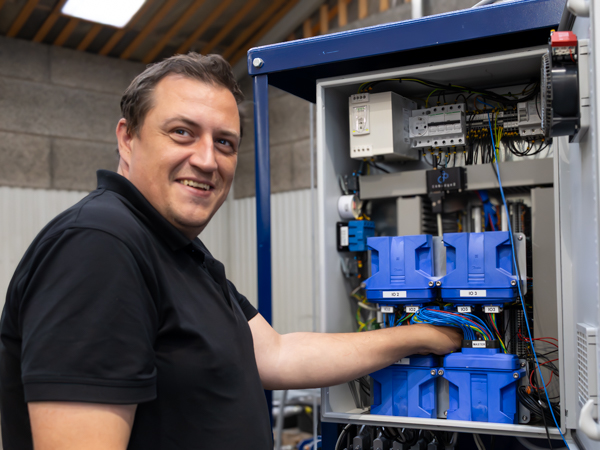
Electrical control system inspection of a Turner Gear control station in the workshop.
Robustness is equally important. Equipment must operate reliably in challenging environments, where external factors such as wind can influence the rotor during installation.
Ease of handling also plays a role. As a temporary installation tool, the system must be practical to transport, install and remove as part of the overall workflow.
Common challenges and how Turner Gear solves them
Blade installation involves several challenges that must be managed carefully to ensure a successful outcome. One of the primary challenges is handling large and unbalanced loads. As blades are installed one by one, the rotor experiences uneven weight distribution, creating forces that must be controlled continuously. A Turner Gear addresses this by providing controlled rotation and holding capability, ensuring that the rotor remains stable even under asymmetric loading conditions.
Another challenge is environmental influence, particularly wind. Wind introduces additional forces on the blades and rotor, which can lead to sudden or unpredictable movement. By enabling controlled and gradual rotation, the Turner Gear reduces the impact of these forces and allows operators to maintain control even in less favourable conditions.
Precision is another critical factor. Blade installation requires accurate alignment to ensure structural integrity and long-term performance. Small deviations can lead to increased wear or operational issues over time. The Turner Gear supports precise positioning, allowing technicians to align components correctly before final fixation.
Finally, time and efficiency are key factors in large wind projects. Delays in installation can have significant cost implications. By improving control, reducing risk and enabling smoother workflows, a Turner Gear contributes to faster and more reliable installation processes.
Conclusion
A Turner Gear is a critical tool in modern wind turbine blade installation. It provides the control and stability required to manage an otherwise unstable and high-risk process. By enabling controlled rotation, supporting precise positioning and improving safety, the Turner Gear plays a central role in ensuring efficient and reliable installation. Whether referred to as a turning gear or turn gear, its function remains the same: to transform a complex and potentially hazardous operation into a controlled and manageable process.
Wind energy installations are also part of a broader energy transition. Technologies such as Power-to-X make it possible to convert electricity from wind turbines into fuels and other energy carriers. You can read more about what Power-to-X is and how it works in practice. One of the key applications is the production of green fuels such as ammonia – see how Power-to-X is used to produce green ammonia.